- <a href="https://library.nhrc.or.th/en" aria-label="home" class="mainMenu"> <em class="fas fa-home"></em> </a>
-
About Us
ย้อนกลับ About Us<a href="https://library.nhrc.or.th/en/history" aria-label="menu" class="submenu-list" target="_self"> History </a> <a href="https://library.nhrc.or.th/en/structure" aria-label="menu" class="submenu-list" target="_self"> Organization </a> <a href="https://library.nhrc.or.th/en/vision" aria-label="menu" class="submenu-list" target="_self"> Vision/Mission </a> <a href="https://library.nhrc.or.th/en/award" aria-label="menu" class="submenu-list" target="_self"> Awards </a> <a href="https://library.nhrc.or.th/en/announce" aria-label="menu" class="submenu-list" target="_self"> Regulation/Notification </a> Organizational PolicyGallery<a href="https://library.nhrc.or.th/en/website-policy" aria-label="menu" class="submenu-list"> Website Policy </a> <a href="https://library.nhrc.or.th/en/website-security-policy" aria-label="menu" class="submenu-list"> Website Security Policy </a> <a href="https://library.nhrc.or.th/en/personal-information-protection-policy" aria-label="menu" class="submenu-list"> Personal Information Protection Policy </a> <a href="https://library.nhrc.or.th/en/privacy-policies" aria-label="menu" class="submenu-list"> Privacy Policy </a> <a href="https://library.nhrc.or.th/en/terms-of-service" aria-label="menu" class="submenu-list"> Terms of Service </a> <a href="https://library.nhrc.or.th/en/cookies-policy" aria-label="menu" class="submenu-list"> Cookies Policy </a><a href="https://library.nhrc.or.th/en/album-image" aria-label="menu" class="submenu-list"> Gallery </a> <a href="https://library.nhrc.or.th/en/gallery360" aria-label="menu" class="submenu-list"> 360° Picture </a>
-
Services
ย้อนกลับ Services<a href="https://library.nhrc.or.th/en/borrow-and-return" aria-label="menu" class="submenu-list" target="_self"> Borrowing Privileges </a> <a href="https://library.nhrc.or.th/en/service" aria-label="menu" class="submenu-list" target="_self"> Services </a> <a href="https://library.nhrc.or.th/en/flow-service" aria-label="menu" class="submenu-list" target="_self"> Workflow Services </a> <a href="https://library.nhrc.or.th/en/imfortable" aria-label="menu" class="submenu-list" target="_self"> Facilities </a> Forms<a href="https://forms.gle/kFvvmB3eMbtTybpn8" aria-label="menu" class="submenu-list" target="_blank"> Satisfaction Survey </a> <a href="https://library.nhrc.or.th/en/event" aria-label="menu" class="submenu-list" target="_self"> Activities </a> <a href="https://library.nhrc.or.th/en/plan" aria-label="menu" class="submenu-list" target="_self"> Directory </a><a href="https://library.nhrc.or.th/en/form-search" aria-label="menu" class="submenu-list"> Information Retrieval Request </a> <a href="https://library.nhrc.or.th/en/form-suggestions" aria-label="menu" class="submenu-list"> Information Resource Request </a>
-
Online Resources
ย้อนกลับ Online Resources<a href="https://library.nhrc.or.th/en/search?ctrl=kw&searchopt=&type=place&keyword=14" aria-label="menu" class="submenu-list" target="_self"> NHRC’s Collections </a> <a href="https://library.nhrc.or.th/en/search" aria-label="menu" class="submenu-list" target="_self"> Collections </a> Resources<a href="https://library.nhrc.or.th/en/network" aria-label="menu" class="submenu-list" target="_self"> Library Networks </a> <a href="https://library.nhrc.or.th/en/dictionary" aria-label="menu" class="submenu-list" target="_self"> Dictionary </a> <a href="https://library.nhrc.or.th/en/sourceresearch" aria-label="menu" class="submenu-list" target="_self"> Research/Dissertations </a> <a href="https://www.tci-thaijo.org/" aria-label="menu" class="submenu-list" target="_blank"> Thai Journals Online (ThaiJO) </a> <a href="https://ncx.dataxet.co/" aria-label="menu" class="submenu-list" target="_blank"> Online News </a> <a href="https://lms.nhrc.or.th/Document/Manual/APA_NHRC.pdf" aria-label="menu" class="submenu-list" target="_blank"> Referencing Style Guide </a><a href="https://library.nhrc.or.th/en/law-of-human-rights" aria-label="menu" class="submenu-list"> Law of Human Rights </a> <a href="https://library.nhrc.or.th/en/international-human-rights" aria-label="menu" class="submenu-list"> International Human Rights </a> <a href="https://library.nhrc.or.th/en/international-human-rights-treaties" aria-label="menu" class="submenu-list"> International Human Rights Treaties </a> <a href="https://library.nhrc.or.th/en/national-human-rights-commissions" aria-label="menu" class="submenu-list"> Human Rights Commission </a> <a href="https://library.nhrc.or.th/en/judgment" aria-label="menu" class="submenu-list"> Judgment </a> <a href="https://library.nhrc.or.th/en/human-rights-online-resources" aria-label="menu" class="submenu-list"> Human Rights Online Resources </a> <a href="https://library.nhrc.or.th/en/un-and-affiliated-agencies" aria-label="menu" class="submenu-list"> UN and Affiliated Agencies </a>
-
Statistics
ย้อนกลับ Statistics<a href="https://library.nhrc.or.th/en/statistic/1" aria-label="menu" class="submenu-list" target="_self"> Onsite Visits </a> <a href="https://library.nhrc.or.th/en/statistic/2" aria-label="menu" class="submenu-list" target="_self"> Circulation Stat </a> <a href="https://library.nhrc.or.th/en/statistic/3" aria-label="menu" class="submenu-list" target="_self"> Reference Services </a> <a href="https://library.nhrc.or.th/en/statistic/4" aria-label="menu" class="submenu-list" target="_self"> Library Collections </a> <a href="https://library.nhrc.or.th/en/statistic/5" aria-label="menu" class="submenu-list" target="_self"> Visitors </a> <a href="https://library.nhrc.or.th/en/statistic/6" aria-label="menu" class="submenu-list" target="_self"> Website Stat </a> <a href="https://library.nhrc.or.th/en/statistic/7" aria-label="menu" class="submenu-list" target="_self"> Annual Reports </a>
-
Contacts
ย้อนกลับ Contacts<a href="https://library.nhrc.or.th/en/faq" aria-label="menu" class="submenu-list" target="_self"> FAQ </a> <a href="https://library.nhrc.or.th/en/opening-hours-close-calendar" aria-label="menu" class="submenu-list" target="_self"> Opening Hours/Close Calendar </a> <a href="https://library.nhrc.or.th/en/contacts-us" aria-label="menu" class="submenu-list" target="_self"> Contacts </a>
-
My Account
ย้อนกลับ My Account<a href="https://library.nhrc.or.th/en/membership-application" aria-label="menu" class="submenu-list" target="_self"> Membership </a> <a href="https://library.nhrc.or.th/en/member/login" aria-label="menu" class="submenu-list" target="_self"> Login </a>
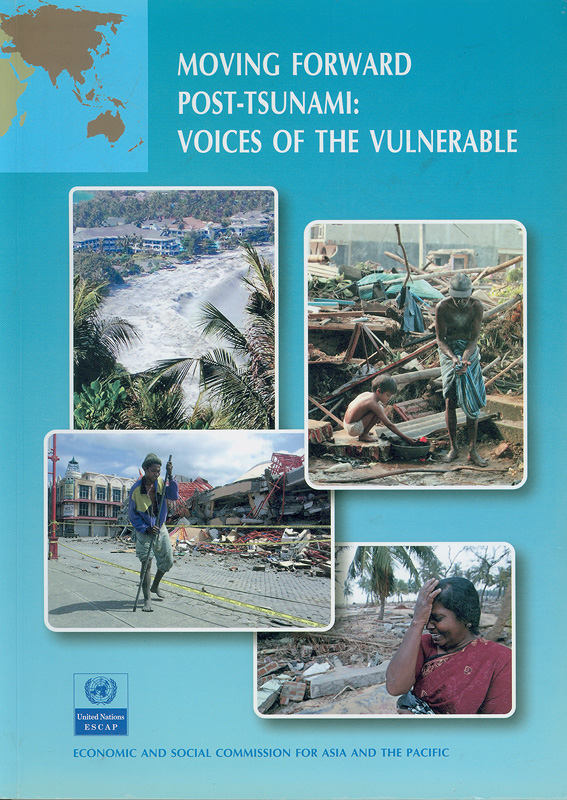
Moving forward post-tsunami : voices of the vulnerable
| Category | Call number | Location | Status | |
|
HV555.I743 M935 2006 |
General Books Zone | On shelf | Reserve |
| ISBN |
9211204739 (pbk.)
|
| Call Number |
HV555.I743 M935 2006
|
| Title |
Moving forward post-tsunami : voices of the vulnerable / United Nations, Economic and Social Commission for Asia and the Pacific
|
| Imprint |
New York : United Nations, Economic and Social Commission for Asia and the Pacific, 2006.
|
| Physical |
xvi, 119 p : ill. ; 30 cm.
|
| Note |
On 26 December 2004, a massive earthquake of magnitude 9.0 (Richter scale) occurred off the west coast of north Sumatra, Indonesia. This was followed by a series of aftershocks that triggered tidal waves (tsunami) that travelled at over 600 km/h causing extensive coastal damage to Indonesia, Malaysia, Myanmar and Thailand. Later on the tsunami reached Bangladesh, India, Maldives, and Sri Lanka. Finally it reached Kenya, Seychelles, Somalia, Tanzania, and Yemen. In all over 2.4 million people were affected, with over 286,000 dead and more than 7,800 missing. The fisheries sector was hit worst by the tsunami, but crop and livestock as well as coastal ecosystems, including mangroves and other crop trees, also suffered serious damages. In terms of economic losses, estimates from India, Indonesia, Maldives, Myanmar, Somalia, Sri Lanka, and Thailand combined put the cost in the fisheries sector alone at US^ 250 million. In agriculture, the damages to crop production were mainly due to intrusion of sea water to agricultural land and deposition of saline sediment, destruction to irrigation and drainage facilities and loss of farming capital. The livelihoods of millions of farmers and fisherfolk of many coastal communities in the affected countries were completely or partially destroyed. Economies at the community level were severely affected, causing hundreds of thousands of already poor people to fall into even deeper poverty. Rebuilding the livelihoods remains one of the main challenges facing the affected Governments and international organizations and its partners following the initial phase of rescue and humanitarian relief. Committed to support the Governments of the tsunami-affected countries in the reconstruction efforts, the United Nations Economic and Social Commission for Asia and the Pacific (ESCAP) organized a study to identify the needs and aspirations of the disaster affected communities in order to identify appropriate intervention strategies especially in relation to vulnerable social groups and livelihood issues
|
| Subject | |
| Subject | |
| Subject | |
| Corporate authur | |
| Link |
| LEADER : 00000nab 2200000uu 4500 |
| 001 3893 |
| 003 NHRC |
| 008 120617s2006||||nyua0000wnfd |
| 020^a9211204739(pbk.) |
| 05000^aHV555.I743^bM9352006 |
| 24500^aMovingforwardpost-tsunami:^bvoicesofthevulnerable/^cUnitedNations,EconomicandSocialCommissionforAsiaandthePacific |
| 260^aNewYork:^bUnitedNations,EconomicandSocialCommissionforAsiaandthePacific,^c2006. |
| 300^axvi,119p:^bill.;^c30cm. |
| 520^aOn26December2004,amassiveearthquakeofmagnitude9.0(Richterscale)occurredoffthewestcoastofnorthSumatra,Indonesia.Thiswasfollowedbyaseriesofaftershocksthattriggeredtidalwaves(tsunami)thattravelledatover600km/hcausingextensivecoastaldamagetoIndonesia,Malaysia,MyanmarandThailand.LateronthetsunamireachedBangladesh,India,Maldives,andSriLanka.FinallyitreachedKenya,Seychelles,Somalia,Tanzania,andYemen.Inallover2.4millionpeoplewereaffected,withover286,000deadandmorethan7,800missing.Thefisheriessectorwashitworstbythetsunami,butcropandlivestockaswellascoastalecosystems,includingmangrovesandothercroptrees,alsosufferedseriousdamages.Intermsofeconomiclosses,estimatesfromIndia,Indonesia,Maldives,Myanmar,Somalia,SriLanka,andThailandcombinedputthecostinthefisheriessectoraloneatUS^250million.Inagriculture,thedamagestocropproductionweremainlyduetointrusionofseawatertoagriculturallandanddepositionofsalinesediment,destructiontoirrigationanddrainagefacilitiesandlossoffarmingcapital.Thelivelihoodsofmillionsoffarmersandfisherfolkofmanycoastalcommunitiesintheaffectedcountrieswerecompletelyorpartiallydestroyed.Economiesatthecommunitylevelwereseverelyaffected,causinghundredsofthousandsofalreadypoorpeopletofallintoevendeeperpoverty.RebuildingthelivelihoodsremainsoneofthemainchallengesfacingtheaffectedGovernmentsandinternationalorganizationsanditspartnersfollowingtheinitialphaseofrescueandhumanitarianrelief.CommittedtosupporttheGovernmentsofthetsunami-affectedcountriesinthereconstructionefforts,theUnitedNationsEconomicandSocialCommissionforAsiaandthePacific(ESCAP)organizedastudytoidentifytheneedsandaspirationsofthedisasteraffectedcommunitiesinordertoidentifyappropriateinterventionstrategiesespeciallyinrelationtovulnerablesocialgroupsandlivelihoodissues |
| 6500^aIndianOceanTsunami,2004 0^aDisastervictims^zIndianOceanRegion 0^aDisasterrelief^zIndianOceanRegion |
| 7102^aUnitedNations.^bEconomicandSocialCommissionforAsiaandthePacific |
| 856 40^3Content^uhttps://lms.nhrc.or.th/Document/Content/T03893.pdf |
| 917 ^aLIB :^c500 |
| 955 ^a1 copy |
| 999 ^acat6 |
before adding tags or comments.